




Cambridge role in wireless initiative unveiled at Mobile World Congress 2026
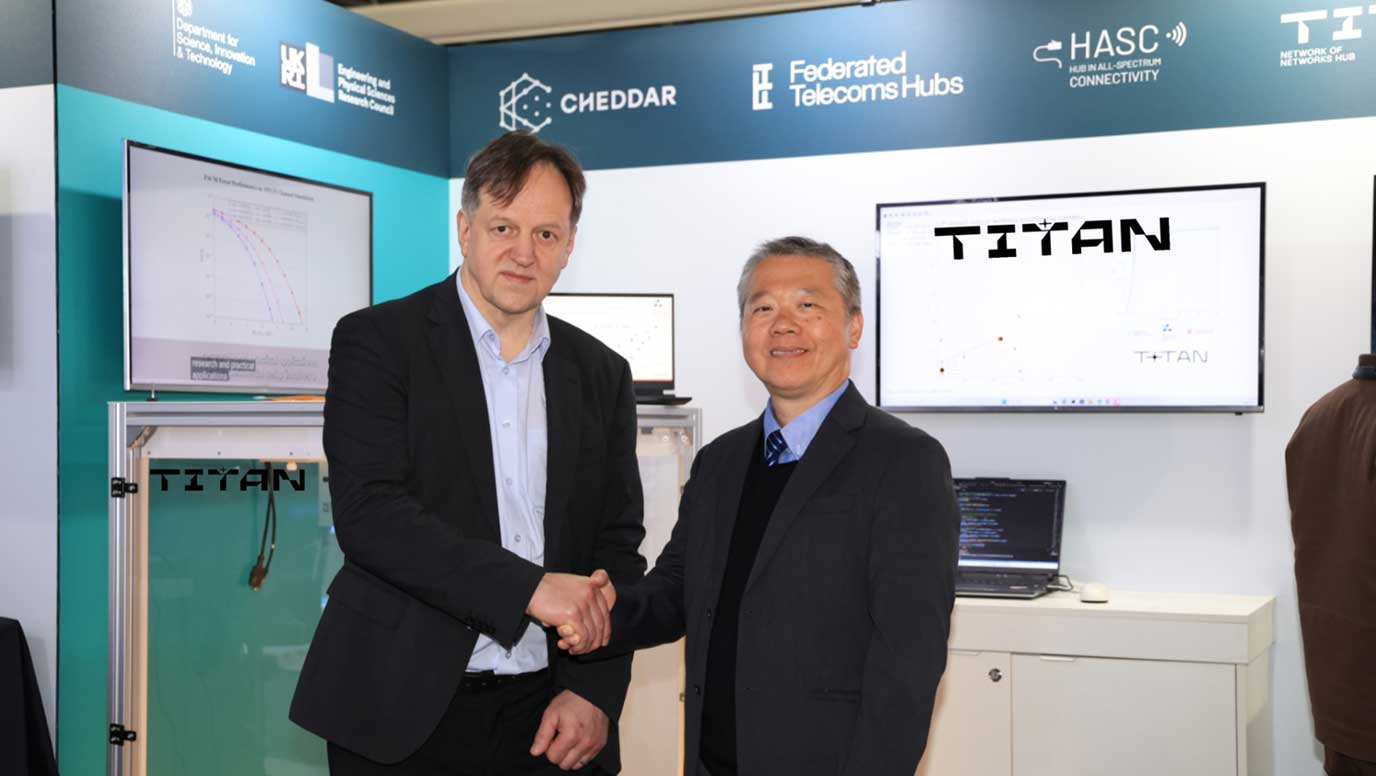
UK-based National Hub on Network of Networks, TITAN, and Taiwan’s Industrial Technology Research Institute (ITRI) are to combine optical wireless platforms and advanced signal processing platforms to demonstrate terrestrial and non-terrestrial networks (NTNs) for 6G and beyond.
The move is designed to strengthen the UK’s position as a leader in advanced connectivity technologies and was enhanced today as TITAN, a member of the Federated Telecoms Research Hubs (FTH) and ITRI signed a Memorandum of Intent. TITAN is one of the four national research hubs within the FTH led by the University of Cambridge.
The collaboration reflects a wider shift in industry thinking ahead of 6G, where experts increasingly view the convergence of terrestrial and space‑based networks as essential to delivering global coverage.
The agreement sets out a framework for deep technical collaboration on advanced 5G and future 6G networks spanning terrestrial and NTN domains, with a particular focus on radio frequency (RF) and optical wireless connectivity.
TITAN Director Professor Harald Haas, who is the Van Eck Professor of Engineering at the University of Cambridge, says: “This partnership between TITAN and ITRI represents a significant step towards the seamless integration of terrestrial and non-terrestrial networks. It brings together global leadership in complementary technology domains, which has the potential to remove existing barriers to the adoption of LiFi and optical wireless communication systems.”
ITRI’s wireless modems, hardware and software will be combined with TITAN’s optical wireless platforms to deliver joint demonstrations in scenarios such as X‑haul and fixed-wireless access. The partners also plan to jointly promote the resulting testbeds and proof‑of‑concepts, through video showcases, press materials and live demonstrations at global industry events.
The collaboration comes as non‑terrestrial networks (NTNs) move from concept to large‑scale testing, with ecosystem players demonstrating 5G NTN connections over operational low earth orbit (LEO) and geostationary earth orbit (GEO) satellites and integrating them into 3GPP standards.
ITRI has already led world‑first, multi‑orbit NTN trials using in‑orbit LEO satellites and commercial GEO systems, providing 5G air interfaces over satellite links and achieving high spectrum efficiency in challenging propagation conditions.
In parallel, TITAN, as a part of the FTH, has been building new enabling technologies such as Doppler robust waveforms for seamless “Network of Networks” across terrestrial and non‑terrestrial infrastructures to underpin future connectivity.
The FTH is showcasing groundbreaking research from across its four hubs: CHEDDAR, HASC, JOINER, and TITAN at Stand 7B43 in Hall 7 at the Mobile World Congress.
Beyond demonstrations, TITAN and ITRI will programme joint trials, workshops and knowledge‑sharing designed to accelerate 5G‑Advanced and 6G research and development.
Planned activities include integrating emerging 6G radio and optical wireless technologies into end‑to‑end trials across different industry verticals, from transport and logistics through to resilient infrastructure and remote industrial automation.
Both partners will also coordinate public events and expert workshops to present progress, and debate key policy issues such as spectrum strategy and standards alignment.
A key aim of the partnership is to move beyond theoretical 6G roadmaps towards commercially deployable, interoperable systems that can support everything from immersive applications and autonomous mobility to large‑scale IoT deployment and critical communications.
By explicitly addressing both technical and ecosystem dimensions -standardisation, supply‑chain resilience and international co‑development - the collaboration aligns with ongoing UK efforts to diversify the telecoms supply chain and increase adoption of home‑grown innovation, as well as Taiwan’s push to position its wireless and satellite industries at the heart of the 6G era.
Within the framework, both partners will deliver joint demonstrations and seek joint funding opportunities. TITAN will leverage its UK‑wide ecosystem of academic, industrial and policy partners, while ITRI will bring its experience in multi‑orbit NTN systems, advanced 5G/6G RF front‑ends and massive multiple input, multiple output (MIMO) technologies developed under Taiwan’s 6G programmes.
The Federated Telecoms Hubs is one of the world’s largest advanced connectivity consortia, conducting cutting-edge telecoms research across 35 UK institutions. It exists to drive cutting-edge research, extensive collaboration, and be a catalyst for telecoms innovation, ensuring the UK harnesses even greater value from its academic distinction.
FTH encompasses four collaborative hubs dedicated to cutting-edge research, unprecedented collaboration, and catalysing telecoms innovation: TITAN, HASC, CHEDDAR and JOINER. It is supported by the Engineering and Physical Sciences Research Council and is backed by the Department of Science, Innovation and Technology.
TITAN is a UK government-funded national telecoms hub focused on designing an intelligent, seamless, open and fully integrated “Network of Networks (NoN)” to enable future ubiquitous connectivity. It exploits AI at all levels to converge wireless and wired networks, creating a resilient, secure and trustworthy NoN that dynamically reconfigures, self-heals and adapts to maximise end-to-end performance while minimising the carbon footprint of connectivity.