




Cambridge's Plastometrex helping to put fresh steel into industry
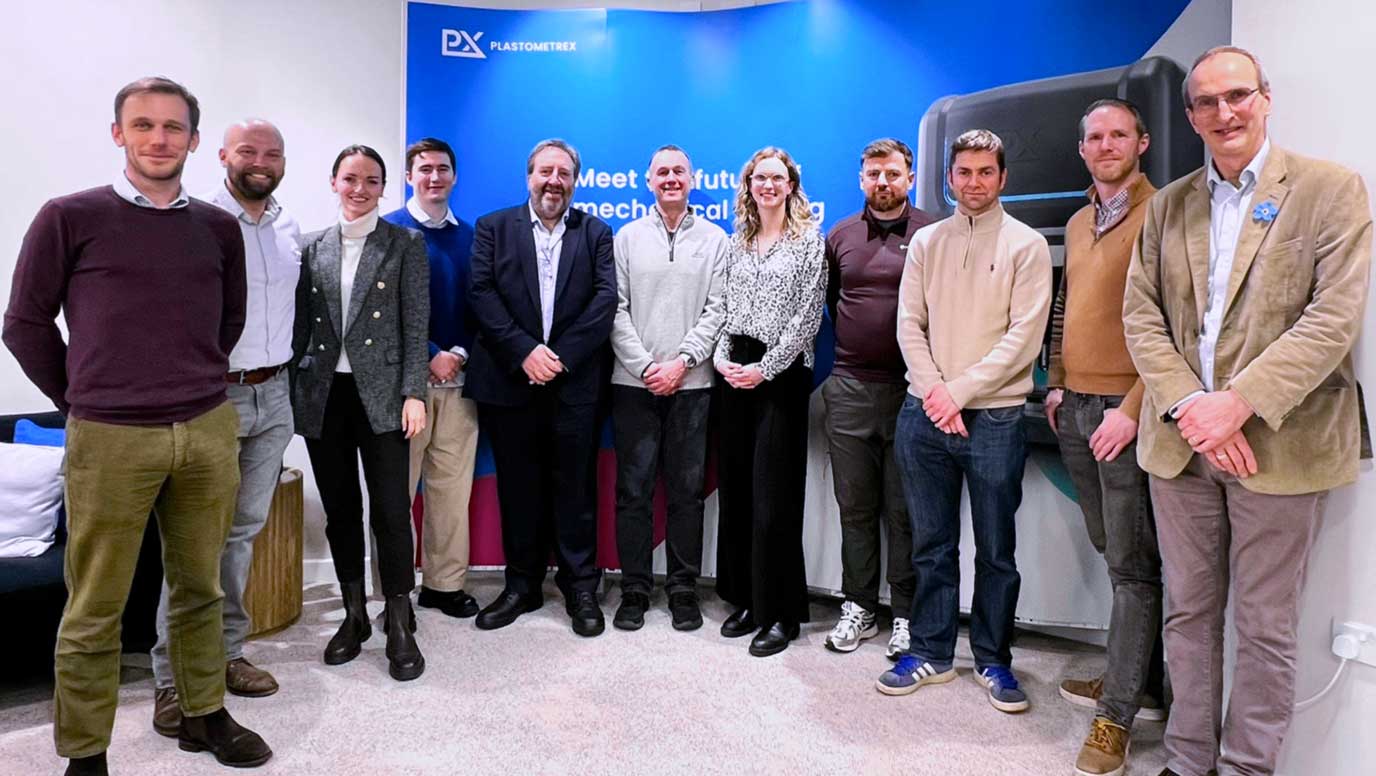
Founded by University of Cambridge materials scientists, Plastometrex develops mechanical testing technology used by engineers to obtain stress-strain data without destructive testing. It is partnering with major global engineering firms to address a key barrier to net zero construction.
This new project, supported by the Department for Energy Security and Net Zero and Defra, will accelerate development of an attachment designed to verify the grade and mechanical performance of structural steel directly within existing buildings.
The issue it addresses is practical and commercial. Steel reuse has clear carbon benefits, but adoption remains limited because building owners, engineers, and developers often lack reliable mechanical data on existing beams. Without defensible data, reuse decisions carry financial and regulatory risk.
By enabling laboratory-equivalent mechanical property insight to be gathered on-site, the project aims to reduce uncertainty in refurbishment and redevelopment schemes and support more confident reuse decisions across the supply chain.
Based at Cambridge Technopark, Plastometrex is partnering WSP and Sandberg on the collaborative project. It has secured Innovate UK funding from the Department for Energy Security and Net Zero (DESNZ) and Defra to deliver the project and improve the accuracy and credibility of structural steel grade verification.
Working alongside WSP and Sandberg, with technical support from Minima Design and Wizzdev and advisory input from Cleveland Steel & Tubes, the project will accelerate development of a new attachment for Plastometrex’s PLX-Portable system, designed to provide laboratory-equivalent mechanical property insight in-situ from structural beams within existing buildings.
This supports both steel salvage prior to demolition and refurbishment or cut-and-carve projects, where improved knowledge of existing structural capacity can enhance design certainty. The system may also be used to verify grade and suitability of salvaged members in stock yards.
Although structural steel reuse offers significantly lower embodied carbon than recycling or new production, adoption remains limited. A key constraint is uncertainty around the true mechanical properties of existing members. Current in-situ approaches typically rely on portable hardness testing, which can introduce ambiguity when differentiating between common structural steel grades.
The project builds on Plastometrex’s Profilometry-based Indentation Plastometry (PIP) technology. By extracting stress-strain curves from indentation measurements using automated inverse finite element analysis, the system aims to provide more robust mechanical property data in operational environments.
The project will advance the technology to TRL7 through development of a dedicated mounting solution for structural member geometries and a guided user interface to support consistent application on site.
Dr Jimmy Campbell, CTO of Plastometrex, said: “For steel reuse to scale, the industry needs greater confidence in the underlying material data. By working closely with inspection specialists and structural engineers, we’re focusing on delivering practical, defensible insight that supports reuse decisions across the supply chain.”
Sandberg will contribute operational expertise and field validation, while WSP will undertake lifecycle carbon modelling and impact analysis to quantify how improved mechanical data could influence reuse outcomes and embodied carbon performance.
Sally Walsh, Associate, WSP said: “We are excited to be involved in this project. We hope that it will help to de-risk and accelerate steel re-use for both existing building owners and developers of new structures, reducing upfront carbon emissions and improving the commercial viability of the process in a space where the UK is leading globally.”
The project will conclude with a live operational demonstration and impact validation report this Spring.